
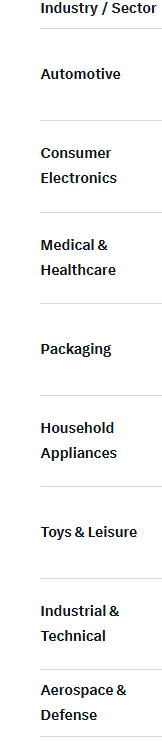
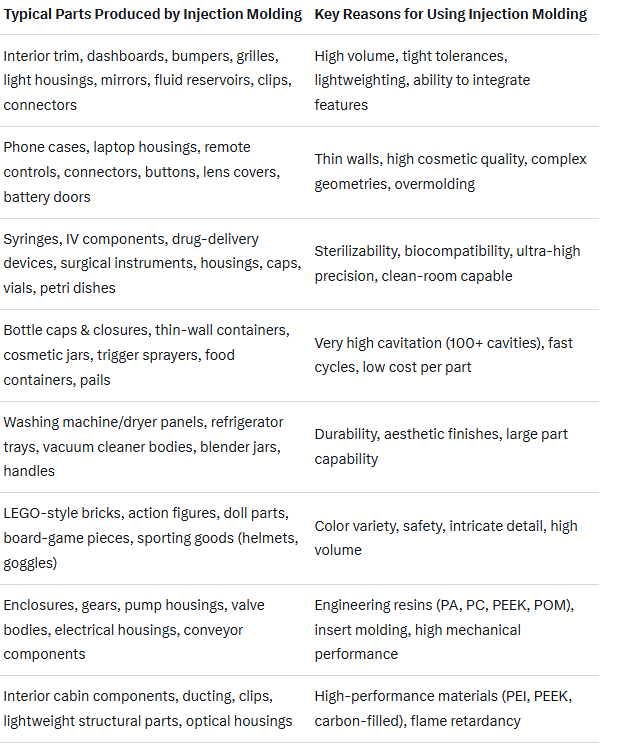
Injection molds (also called injection molds or injection tooling) are one of the most important manufacturing processes in modern industry. They are used to mass-produce plastic parts with high precision, excellent surface finish, and very high repeatability at relatively low piece-part cost. Below are the main industrial fields where injection molding is widely applied and the typical applications in each field:
Key Advantages That Make Injection Molding Dominant in Industry
1.Economies of scale – After the mold is paid for (which can be expensive), the cost per part is extremely low, often cents.
2.Design freedom – Undercuts, threads, living hinges, snap-fits, and very complex geometries are possible.
3.Material range – From commodity resins (PP, PE, ABS) to high-performance engineering polymers (PA66, PBT, PC, PEEK, LCP) and even bio-based or biodegradable plastics.
4.Finishing options – In-mold decoration (IMD), overmolding (soft-touch TPE over rigid substrate), insert molding (metal threads, bushings), two-shot/multi-shot molding.
5.Automation & speed – Cycle times of 10–60 seconds with fully automated part removal and quality inspection.
6.Consistency & precision – Tolerances routinely ±0.02 mm to ±0.05 mm; critical medical and optical parts can reach ±0.005 mm.
Emerging & Specialized Applications (2020s–2025)
1.Micro-injection molding (parts<1 g, tolerances <10 µm) → hearing aids, micro-fluidic “lab-on-chip” devices.
2.Metal (MIM) and Ceramic (CIM) injection molding → watch cases, cutting tools, turbine blades.
3.Sustainable molding → bio-resins, recycled content, chemical recycling compatibility.
4.Liquid Silicone Rubber (LSR) molding → baby bottle nipples, medical seals, wearable devices.
5.High-cavitation thin-wall molding for sustainable lightweight packaging (e.g., IML yogurt cups).
In short, if a plastic part is produced in quantities from several thousand to hundreds of millions per year and requires precision, consistent quality, and low unit cost, injection molding is almost always the manufacturing method of choice across virtually every industrial sector.