The ideal wall thickness for 3D prints depends on your printer type (FDM vs. resin), nozzle/size, material, and what the part needs to do (cosmetic, functional, structural, etc.). Here are the practical guidelines most people follow in 2025:
FDM/FFF Printers (PLA, PETG, ABS, etc.)
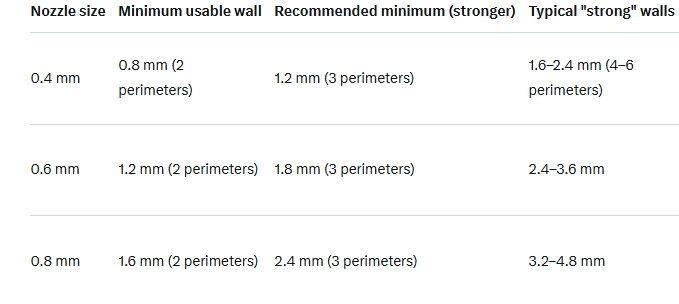
Wall thickness should almost always be a multiple of your nozzle diameter so the slicer can lay down complete, solid perimeters without gaps.
Rule of thumb for FDM:
a.Cosmetic/light-duty parts → 1.2 mm (3 perimeters with 0.4 mm nozzle) is the sweet spot.
b.Functional parts that take some force → 1.6–2.4 mm (4–6 perimeters).
c.Very strong parts (brackets, mounts, robot parts) → 2.4–4.0 mm or more.
Extra tips for FDM:
a.Never use 1 perimeter only (0.4 mm) unless it’s purely decorative — it’s extremely fragile.
b.Using more perimeters is almost always stronger than the same thickness in infill.
c.For maximum strength in a given wall thickness, set “wall loops” instead of relying on infill to fill the space.
Resin (SLA/DLP/MSLA) Printers
a.Resin prints are naturally solid and isotropic, so walls can be thinner:Minimum reliable: 0.5–0.8 mm (depending on resin and exposure)
b.Cosmetic shells / figurines: 1.0–1.5 mm
c.Functional resin parts: 2.0–3.0 mm (still very strong at this thickness)
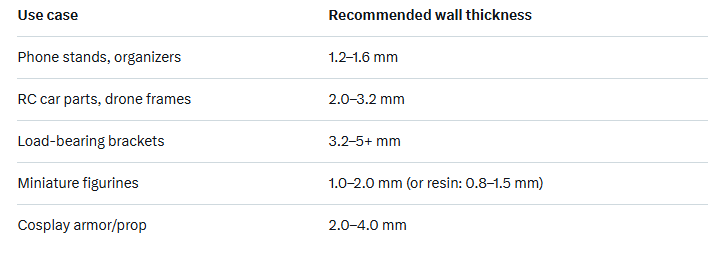
Quick Cheat Sheet by Use Case (FDM, 0.4 mm nozzle)