What is input shaping 3d printing?
Input shaping is a vibration-reduction technique used in modern 3D printers (especially high-speed CoreXY machines like Bambu Lab X1/P1/A1, Prusa MK4/XL with input shaper, Voron, RatRig, Creality K1, Anycubic Kobra 2 Pro, etc.) to dramatically reduce or eliminate ringing/ghosting artifacts while allowing much faster print speeds.
What problem does it solve?
When a 3D printer’s printhead accelerates, decelerates, or changes direction quickly, the frame and mechanical components resonate at certain natural frequencies. These vibrations show up on the print as “ringing” or “ghosting” — wavy patterns or duplicated features, especially visible after sharp corners.Traditional solution: Print slower (lower acceleration/jerk) so the vibrations never get excited in the first place.Input shaping solution: Let the printer move fast, but intelligently cancel out the vibrations before they happen.
How Input Shaping Works (simply)
The printer has an accelerometer (usually built into the mainboard or toolhead).
During a calibration routine, the printer bangs the axes around and measures how the frame rings (resonance frequencies, usually 30–150 Hz depending on the printer).
The firmware (Klipper is the most common, Marlin also supports it now) calculates a very short “shaper” filter (typically 2–4 pulses lasting 10–50 ms).
Instead of sending one big acceleration command to the motors, the firmware splits it into a sequence of smaller pulses that are timed so the vibrations from the first pulse cancel out the vibrations from the later pulses.
Result → almost zero ringing even at 10,000–20,000 mm/s² acceleration and 300–600 mm/s speeds.
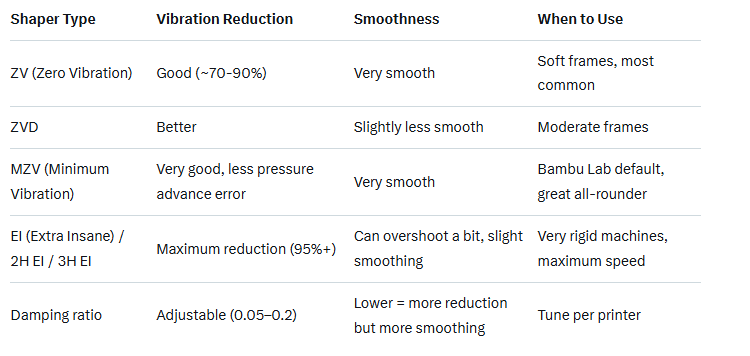
Common Types of Input Shapers