
3D printing (also called additive manufacturing) builds objects layer by layer from the bottom up, which is the opposite of traditional “subtractive” manufacturing (like CNC milling that cuts material away).Here’s the step-by-step process that almost all 3D printers follow:
1.Create or download a 3D model
You need a digital 3D file, usually in .STL or .OBJ format.
You can design it yourself in software (Blender, Fusion 360, Tinkercad, etc.) or download ready-made models from sites like Thingiverse, Printables, or MyMiniFactory.
2.Slice the model
A program called a slicer (PrusaSlicer, Cura, Bambu Studio, Orca Slicer, etc.) takes the 3D model and “slices” it into hundreds or thousands of horizontal layers (usually 0.05–0.4 mm thick).
The slicer also generates the exact toolpath the printer will follow and adds support structures if needed.
3.Send the instructions to the printer
The slicer outputs a file (usually G-code) that tells the printer exactly where to move, how hot to get, how fast to go, etc.
You send this file to the printer via USB, SD card, Wi-Fi, or directly from the slicer.
4.The printer builds the object layer by layer
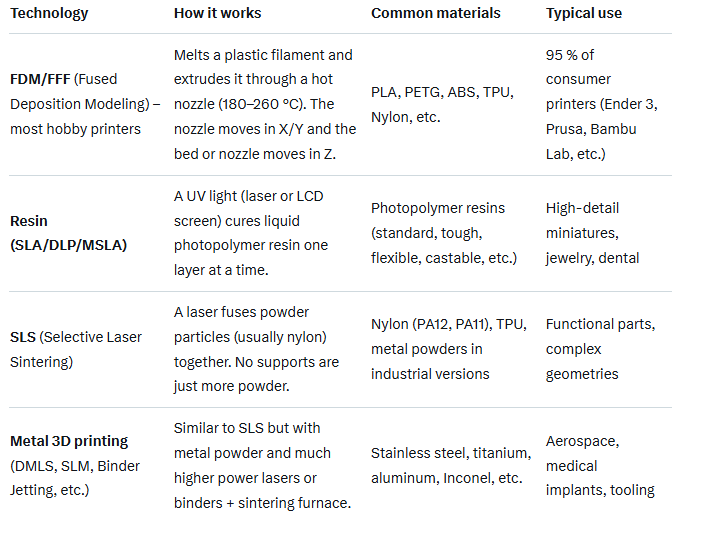
Different technologies do this in different ways. The most common ones are:
5.Post-processing
FDM: Remove supports, sand, paint, acetone smooth (for ABS), etc.
Resin: Wash in isopropyl alcohol, cure under UV light, remove supports.
SLS: Remove excess powder (which can be reused), sometimes bead blasting or dyeing.