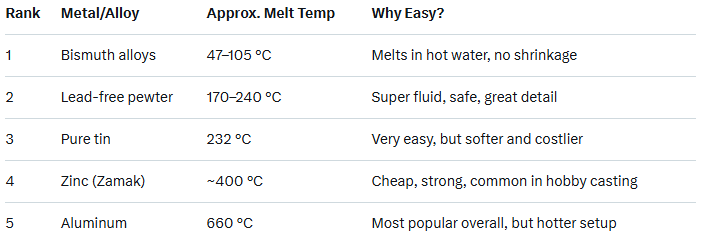
The easiest metal to cast—especially for beginners, hobbyists, or small-scale foundry work—is tin-based alloys, with pure tin or low-melting pewter being the absolute easiest.
Here’s why, ranked by practical ease of casting:
1.Pure Tin
A.Melting point: ~232 °C (450 °F)
B.Can be melted in a simple steel ladle over a propane torch or even on a kitchen stove.
C.Very low shrinkage, excellent fluidity, no dangerous fumes, casts sharp details.
D.Downside: Expensive and very soft (not suitable for structural parts).
2.Modern Lead-Free Pewter (tin + antimony + copper or bismuth)
A.Melting point: 170–240 °C (338–465 °F) depending on exact alloy
B.Extremely popular for jewelry, figurines, and spin-casting.
C.Flows like water, minimal shrinkage, reusable scrap, safe (no lead).
D.Widely considered the “easiest” metal for lost-wax, silicone mold, or sand casting at home.
3.Bismuth-based alloys (e.g., CerroLOW, Wood’s metal, Field’s metal)
A.Melting points as low as 47–105 °C (117–221 °F) — some melt in boiling water!
B.Zero shrinkage or even slight expansion on cooling → perfect fill-out and easy release.
C.Used for proofing molds, anchoring, and very low-temperature casting.
D.Slightly brittle and more expensive.
4.Zinc alloys (Zamaks)
A.Melting point: ~380–420 °C
B.Very common in hobby die-casting and sand casting. Cheap, good strength, nice finish.
C.Requires a bit more heat than pewter but still manageable with a small crucible furnace.
5.Aluminum (most common beginner metal after the above)
A.Melting point: ~660 °C
B.Cheap, widely available (scrap cans, etc.), lightweight, corrosion-resistant.
C.Needs a proper crucible and furnace or good torch setup; more shrinkage and dross than tin/pewter
Summary – Easiest → Hardest (for beginners):