What is Metal Casting?
Metal casting is a foundational manufacturing process used to create complex metal parts by pouring molten metal into a mold shaped like the desired final product. Once the metal cools and solidifies, the mold is removed, leaving a "casting" that can be finished as needed. This method is ideal for producing intricate shapes that would be difficult or costly to machine from solid stock. It works on the principle of solidification, where liquid metal forms solid crystals through nucleation (starting points for solidification) and growth, influenced by cooling rates that affect the material's strength and microstructure.
Main Steps in the Metal Casting Process
The process generally follows these key steps:
1.Pattern Creation: A reusable pattern (often made of wood, plastic, or metal) is crafted as a replica of the final part, including allowances for shrinkage, draft angles (for easy removal), and machining.
2.Mold Preparation: The pattern is placed in a frame (flask), and molding material—like sand mixed with binders—is packed around it to form the mold cavity. Cores may be inserted for internal features (e.g., holes). The pattern is removed, leaving the negative space. A gating system (sprue for pouring, runners and gates to direct flow, and vents for gases) and risers (to feed extra metal during shrinkage) are added.
3.Melting and Pouring: The metal (e.g., aluminum, steel, or copper alloys) is melted in a furnace to a precise temperature. It's then poured into the mold via gravity, pressure, vacuum, or tilting to minimize turbulence, oxidation, and impurities (dross).
4.Solidification and Cooling: The molten metal cools, transitioning from liquid to solid. Faster cooling near mold walls creates fine grains for strength; slower central cooling forms coarser structures.
5.Extraction and Finishing: The solidified casting is removed (breaking expendable molds or ejecting from reusable ones). It's inspected for defects (e.g., porosity via X-rays), then cleaned, heat-treated, machined, or surface-finished.
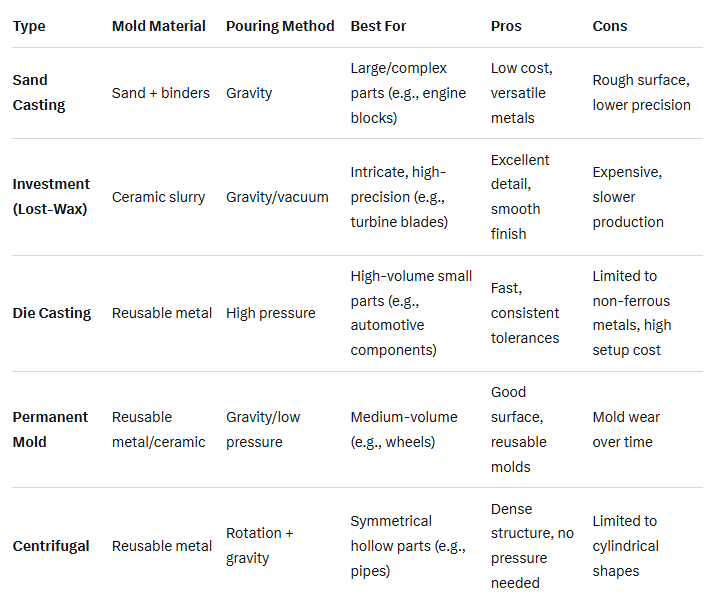
Common Types of Metal Casting: