
Rapid Prototyping vs. Traditional Prototyping: Which is Best for Your Project?
In product development, speed, cost, and accuracy are everything. Whether you are designing a consumer electronic device, an automotive component, or a medical instrument, choosing the right prototyping method can make or break your time-to-market.
For modern hardware startups and established OEMs alike, the choice often boils down to Rapid Prototyping versus Traditional Prototyping.
But what is the difference between these two approaches, and how do you know which one is right for your project? At Alu Rapid Prototype, we specialize in helping businesses navigate these manufacturing choices. Below, we break down the key differences, pros, cons, and costs of each method.
Defining the Contenders
Before comparing them head-to-head, let’s define exactly what each method entails.
What is Rapid Prototyping?
Rapid Prototyping relies on advanced digital manufacturing technologies to quickly turn a 3D CAD model into a physical part. This process is highly automated and typically toolless, meaning it doesn't require custom molds, dies, or complex manual setups.
Core Technologies: 3D printing (SLA, SLS, FDM, DMLS), high-speed CNC machining, and rapid vacuum casting.
What is Traditional Prototyping?
Traditional Prototyping relies on conventional, often manual, manufacturing processes. It frequently involves skilled machinists, manually operated toolrooms, or the creation of soft tooling (like temporary molds) to replicate the final manufacturing method as closely as possible.
Core Technologies: Manual milling and turning, sheet metal fabrication, soft-tool injection molding, and traditional pattern-making.
Head-to-Head Comparison: Rapid vs. Traditional
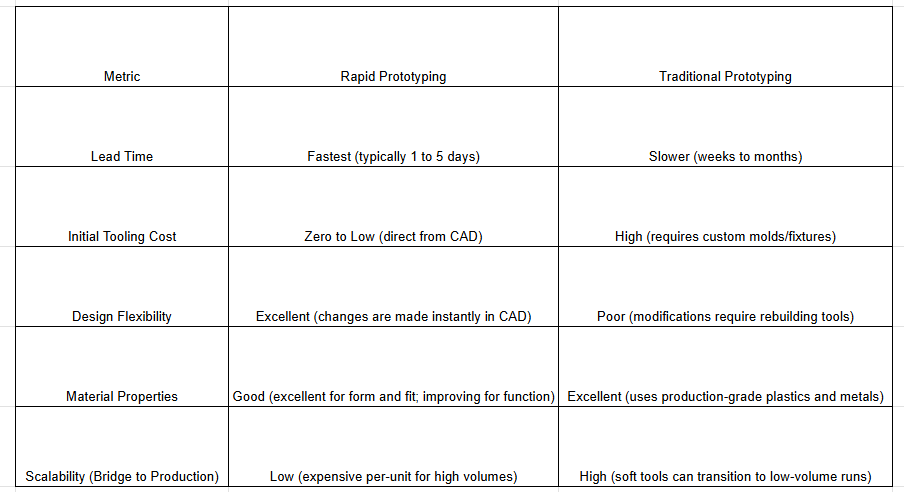
To help you choose the best approach for your design cycle, here is how the two methods compare across five critical manufacturing metrics:
The Pros and Cons: A Detailed Look
1. Speed and Time-to-Market
Rapid Prototyping: By eliminating the need for custom tooling, parts can be built within hours of finalizing a CAD design. This allows engineering teams to perform multiple design-test-redesign iterations in a single week.
Traditional Prototyping: Setting up traditional machinery or cutting a steel tool takes time. If you discover a design flaw after the tool is made, you must modify the tool or start over, adding weeks to your timeline.
2. Upfront Costs vs. Unit Costs
Rapid Prototyping: Has virtually no setup cost, making it incredibly cost-effective for 1 to 10 units. However, the cost per part remains relatively flat, meaning it is not economical for large quantities.
Traditional Prototyping: Requires higher upfront costs for fixtures or temporary tooling. However, once the setup is complete, the cost per part drops dramatically. It is the ideal choice for functional test runs of 100 to 1,000+ units.
3. Material and Structural Accuracy
Rapid Prototyping: While metal 3D printing and rapid CNC are highly accurate, some plastic 3D printing methods do not perfectly match the mechanical properties (tensile strength, thermal resistance) of injection-molded plastics.
Traditional Prototyping: Because it uses the exact same materials and processes as mass production, these prototypes are structurally identical to the final product. This is critical for rigorous stress testing, drop testing, and regulatory certifications.
When to Use Which?
To maximize efficiency and budget, most successful product launches actually utilize both methods at different stages of the development cycle.
[ Concept Design ] ──> [ Rapid Prototyping (Form/Fit) ] ──> [ Traditional Prototyping (Functional Test) ] ──> [ Mass Production ]
Choose Rapid Prototyping if:
You are in the early to mid-stages of design and need to test physical ergonomics, form, and visual aesthetics.
You need a physical model urgently for an upcoming investor meeting or trade show.
Your design is complex, organic, or impossible to machine using traditional subtractive methods.
Choose Traditional Prototyping if:
You have finalized the design and need to perform rigorous functional, thermal, or mechanical testing.
You need to produce a pilot run of 50 to 500 units for beta testing with real users.
Your part must be made from a highly specific production-grade alloy or plastic that cannot be 3D printed.
Streamline Your Prototyping with Alu Prototype
At Alu Rapid Prototype, we don't force you to choose between speed and quality. We offer a comprehensive suite of prototyping services tailored to your project's specific stage:
Rapid CNC Machining: Get precision metal and plastic parts in as fast as 3 days.
Rapid Tooling & Low-Volume Injection Molding: The perfect bridge from prototype to production using aluminum and soft steel molds.
Sheet Metal Prototyping: Fast turnaround on bent, stamped, and welded assemblies.
Ready to accelerate your product development? Upload your CAD files to www.aluprototype.com for a rapid quote and let our engineering team guide you to the most efficient manufacturing path.