
Rapid Prototyping in Industrial Applications: Accelerating Innovation and Reducing Costs
In today’s fiercely competitive manufacturing landscape, speed and precision are the twin pillars of success. Rapid Prototyping (RP) has evolved from a simple design verification tool into a strategic asset that optimizes product development workflows and mitigates R&D risks in the industrial sector.
At Aluprototype, we understand that leveraging the right prototyping technology is the key to transforming innovative concepts into production-ready reality seamlessly.
What is Industrial-Grade Rapid Prototyping?
Rapid prototyping encompasses a range of technologies that utilize CAD data to construct physical models, whether through additive manufacturing (3D printing) or subtractive manufacturing (such as high-precision CNC machining). In an industrial context, it is no longer just about "printing a model"—it is about functional validation, rigorous performance testing, and low-volume production.
Key Benefits for Industrial Applications
1. Drastically Reduced Time-to-Market
In traditional manufacturing, tooling can take weeks or months. With rapid prototyping, engineers can obtain physical parts in days or even hours, allowing for immediate design iteration and early-stage defect detection.
2. Significant Cost Mitigation
By verifying designs through prototypes first, companies avoid the massive capital expenditure of expensive molds before the design is finalized. This "fail fast, learn fast" approach prevents costly errors during mass production.
3. Freedom for Complex Geometry
Industrial design is increasingly moving toward lightweighting and integrated functionality. Additive manufacturing enables the creation of complex internal channels, lattice structures, and organic geometries that traditional machining simply cannot achieve.
4. Bridge Manufacturing for Small Batches
For sectors like aerospace, medical devices, and automotive, rapid prototyping often serves as Bridge Manufacturing. It allows companies to fulfill early market demand or create specialized, low-volume components while final production tooling is still in development.
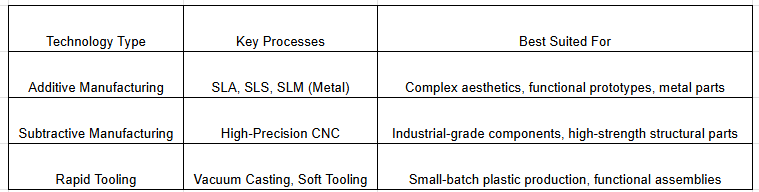
Common Industrial Prototyping Technologies
Choosing the right technology is critical to the success of your project:
How Aluprototype Supports Your Vision
At Aluprototype, we specialize in providing high-end, industrial-grade prototyping solutions. Whether you require high-strength metal functional parts or precision-engineered cosmetic samples, we provide:
Rapid Turnaround: Efficient workflows to ensure your prototypes are delivered exactly when you need them.
Strict Tolerance Control: Meeting industrial-grade assembly standards to ensure your prototype performs like the final product.
Diverse Material Expertise: From engineering-grade plastics to aluminum alloys and stainless steel, we cover a wide range of industrial applications.
Conclusion: Embrace the Future of Manufacturing
Rapid prototyping is no longer just a luxury—it is an indispensable accelerator in the modern industrial process. By integrating these technologies, companies can focus on innovation rather than getting stalled by long lead times.
Are you looking for a tailored rapid prototyping solution for your next industrial project? Visit us atwww.aluprototype.comor contact our engineering team today to discuss how we can help bring your designs to life.