
Key Characteristics of Aluminum Prototypes
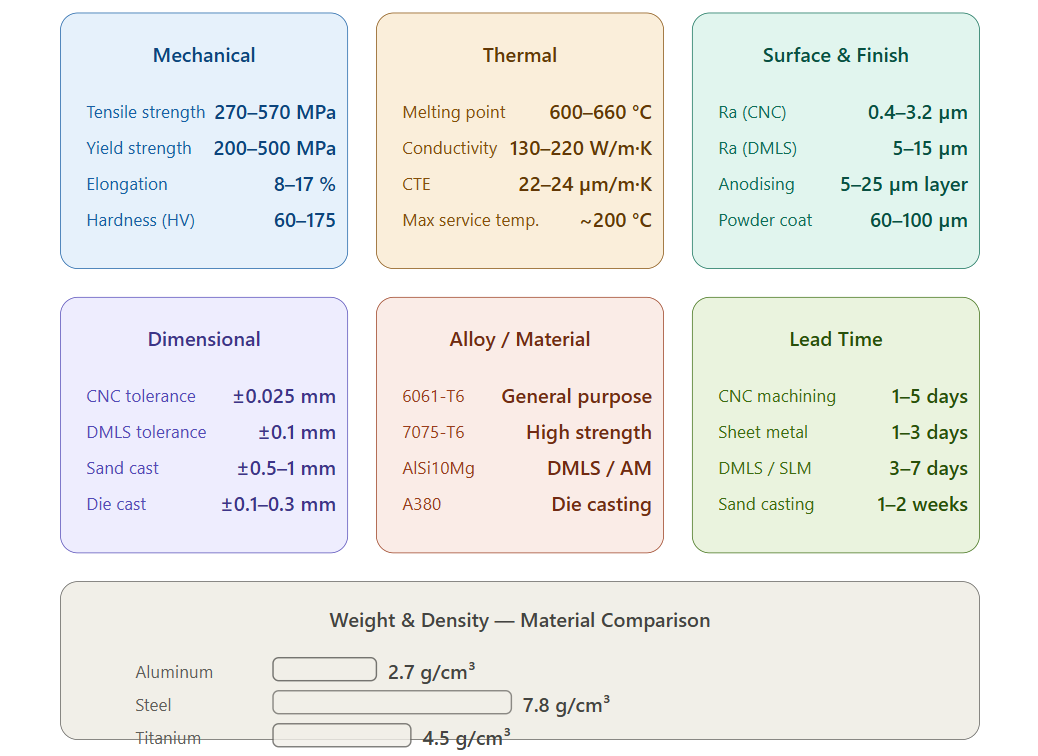
Here's a summary of what makes aluminum prototypes stand out across six key dimensions:
Mechanical — Aluminum alloys like 6061-T6 and 7075-T6 offer impressive strength-to-weight ratios. Tensile strength ranges from 270 to 570 MPa depending on alloy and temper, making them viable substitutes for steel in many structural prototype tests.
Thermal — Aluminum's high thermal conductivity (130–220 W/m·K) makes it ideal for heat sink prototypes and thermal management testing, though its service temperature caps around 200°C.
Surface & Finish — CNC-machined aluminum achieves excellent surface quality (Ra 0.4–3.2 µm), while DMLS parts are rougher and usually need post-processing. Anodising adds hardness, corrosion resistance, and colour in a single step.
Dimensional Accuracy — CNC machining leads with tolerances as tight as ±0.025 mm. Additive methods like DMLS achieve ±0.1 mm, and casting processes are looser but faster for complex geometry.
Alloy Selection — The alloy choice is the biggest driver of prototype performance. 6061-T6 is the everyday workhorse; 7075-T6 is used when maximum strength is needed; AlSi10Mg is the standard for metal 3D printing.
Weight — At 2.7 g/cm³, aluminum is roughly one-third the density of steel and 40% lighter than titanium — a critical advantage for aerospace, automotive, and portable device prototypes.