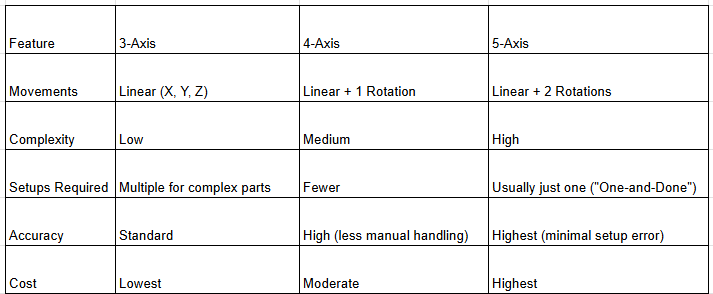
The core difference between these machining centers lies in the number of directions (axes) the cutting tool and the workpiece can move relative to each other. As you move from three to five axes, you gain the ability to create more complex geometries with fewer setups.
For your work with precision valve bodies and aluminum chair components, understanding these distinctions is critical for optimizing both part strength and manufacturing cost.
1. Three-Axis Machining (X, Y, Z)
This is the most common and basic form of CNC machining. The tool moves along three linear axes:
X-axis: Left to right.
Y-axis: Front to back.
Z-axis: Up and down.
Best For: Simple parts with flat surfaces or shallow curves.
Limitations: You can only machine one side of the part at a time. If you need to drill a hole on the side of a valve body, a technician must manually stop the machine, rotate the part, and reset the coordinates (a "second setup").
2. Four-Axis Machining (X, Y, Z + A)
Four-axis machining adds a rotational axis (usually called the A-axis) to the standard three. This typically involves a "rotary table" or indexer that spins the workpiece around the X-axis.
Capabilities: The machine can rotate the part while the tool is cutting.
Best For: Parts that require continuous machining around a cylinder or holes/features on multiple sides of a block.
Advantage for you: If you are manufacturing the cylindrical housing for a valve, 4-axis allows you to machine the entire outer circumference in a single setup, ensuring perfect concentricity.
3. Five-Axis Machining (X, Y, Z + A + B/C)
Five-axis machines use the three linear axes plus two rotational axes. This allows the tool to approach the part from virtually any direction.There are two main types:
3+2 Machining (Positional): The two rotational axes lock the part into a specific angle, and then the 3-axis cutting happens.
1.Simultaneous 5-Axis: All five axes move at the same time during the cut.
2.Best For: Highly complex, organic shapes, impellers, or deep cavities with undercut features.
Advantages:
Surface Finish: Because the tool can stay tangent to a curved surface, the finish is significantly smoother than 3-axis "stepping."
Tool Length: You can use shorter, more rigid cutting tools by tilting the part toward the spindle, which reduces vibration and improves accuracy—vital for high-precision engineering.
Technical Comparison Table