Designing aluminum heat sinks for CNC machining requires a balance between thermal performance and manufacturing efficiency. While thin fins and deep pockets improve surface area, they can significantly increase machining time, tool breakage risks, and cost.
Here is a DFM (Design for Manufacturing) guide focused on optimizing CNC-machined aluminum heat sinks.
1. Material Selection
For CNC heat sinks, the choice typically comes down to thermal conductivity versusmachinability.
1.6061-T6 Aluminum: The "all-rounder." It offers good thermal conductivity ( 167 W /m .K) and excellent machinability. It is the most cost-effective choice for most enclosuresand cooling blocks.
2.6063 Aluminum: Slightly better thermal properties ( 200 W/m K) but can be"gummier" during CNC milling compared to 6061. It is more common in extrusions butoften used for machined parts requiring higher efficiency.
3.1100 or 1050 Aluminum: Highest thermal conductivity but very soft and difficult tomachine without burring or deformation. Avoid unless extreme thermal performance isrequired.
2. Fin Design and Ratios
The fins are the most critical and difficult part of a heat sink to machine.
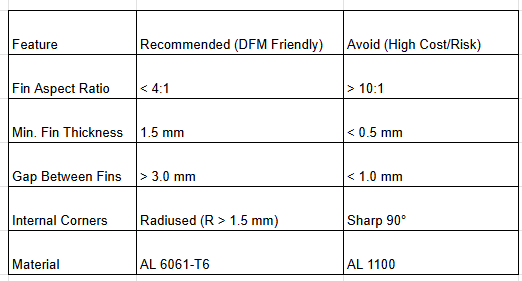
1.Aspect Ratio (Depth-to-Width): Keep the ratio of fin height to fin thickness below 4:1. While 10:1 is technically possible with specialized long-reach tools, it leads to tool chatter, vibration, and poor surface finish.
2.Minimum Fin Thickness: Aim for a minimum of 1.0 mm to 1.5 mm. Thinner fins (e.g., 0.5 mm) tend to vibrate during machining, resulting in a "wavy" appearance or snapping under tool pressure.
3.Fin Spacing (Gap): Ensure the gap between fins is at least 3 mm. This allows for a standard-sized, rigid end mill to pass through. Using very small cutters (e.g., 1 mm) requires much slower feed rates and increases the risk of tool breakage.
3. Pocket and Base Geometry
1.Internal Radii: Never design sharp 90-degree vertical corners between fins or inside pockets. All internal corners should have a radius slightly larger than the radius of the cutting tool (e.g., if using a 3 mm tool, use a 1.6 mm or 2 mm radius).
2.Base Thickness: Maintain a base thickness of at least 3 mm. A base that is too thin relative to the fin height can warp during machining due to the release of internal material stresses.
3.Floor Fillets: Adding a small radius (0.5 mm) where the fin meets the base improves both strength and thermal flow, though it requires a ball-nose end mill or a bull-nose tool.
4. Tolerances and Surface Finish
1.Standard Tolerances: Stick to 0.1 mm for general dimensions. Tightening tolerances to+0.02 mm on non-mating fin surfaces adds unnecessary cost.
2.Surface Roughness: A standard "as-machined" finish (Ra 3.2 m) is usually sufficient.If the heat sink mates with a CPU or power component, specify a face-milled finish (Ra 0.8 um or better) only for that specific contact surface.
3.Deburring: CNC machining leaves sharp edges. Specify "break all sharp edges" (typicallya 0.1-0.2 mm chamfer) to prevent handling injuries and improve plating coverage.
5. Post-Processing Considerations
1.Anodizing: Black or clear anodizing is common. Note that anodizing can slightly change dimensions (usually adding 5–25 microns). If a thermal interface surface must be perfectly flat, it may need to be masked during anodizing or machined/lapped afterward.
2.Thermal Interface: Ensure the mounting holes are through-holes or have sufficient thread depth to ensure high clamping pressure between the heat sink and the heat source.
Summary Table for Quick Reference