
The most common and effective way to remove scratches from an injection mold (typically made of tool steel like P20, H13, S136, etc.) is through progressive mechanical polishing. This removes material in a controlled way to eliminate the scratch while restoring the desired surface finish (from matte to high mirror polish, depending on your part requirements).
Key Principles Before Starting
1.Always work from coarser to finer abrasives — never skip grits, or you'll leave deeper scratches that are harder to remove later.
2.Change direction (90°) with each grit level to see when previous scratches are gone.
3.For mirror finishes (SPI A1/A2), you must go all the way to very fine diamond paste.
4.Use clean tools/lubricants to avoid cross-contamination.
5.For very deep gouges (>0.1–0.2 mm), you may need TIG welding + re-machining first before polishing.
6.Light to medium scratches (visible but not deep gouges) can usually be fixed by polishing alone.
Standard Step-by-Step Process to Remove Scratches
1.Assessment & Preparation
Clean the mold thoroughly (use a non-abrasive, fast-evaporating mold cleaner to avoid new scratches).
Evaluate scratch depth: light hairline → start around 400–600 grit; medium → possibly start lower.
2.Rough/Intermediate Stone or Paper Stage (remove the scratch)
Oil stones (aluminum oxide or India stones) or wet/dry sandpaper: 320–600 grit.
For small/medium scratches: start ~400 grit if needed, then 600, 800, 1000–1200.
Use light pressure, keep surface wet with honing oil or water.
Goal: completely remove the scratch and leave only uniform scratches from the current grit.
3.Fine Stone / Paper Stage
Continue to 1200–2000 grit wet/dry paper or fine polishing stones (e.g., ceramic or Arkansas stones).
Many shops use Gesswein or similar moldmaker stones in progression.
4.Diamond Paste / Compound Stage (achieve smooth to mirror finish)
Apply diamond paste (progress from coarser to finer):
Typical sequence: 15–30 μm → 9 μm → 6 μm → 3 μm → 1 μm → 0.5 μm or 0.25 μm (for true mirror).
Use felt sticks, wood sticks with paste, or felt bobs on a rotary tool (low speed).
Lubricant: kerosene, WD-40 Specialist, or专用 diamond lubricant.
Hand polish or use die grinder/polishing motor at low RPM.
5.Final Buffing (for high gloss)
Ultra-fine compounds (e.g., yellow rouge, alumina, or 0.1–0.25 μm diamond).
Wool pads, horsehair brushes, or hand buffing with microfiber.
6.Inspection
Use a surface roughness tester (profilometer) if available.
Check under strong angled light or with replica tape for remaining scratches.
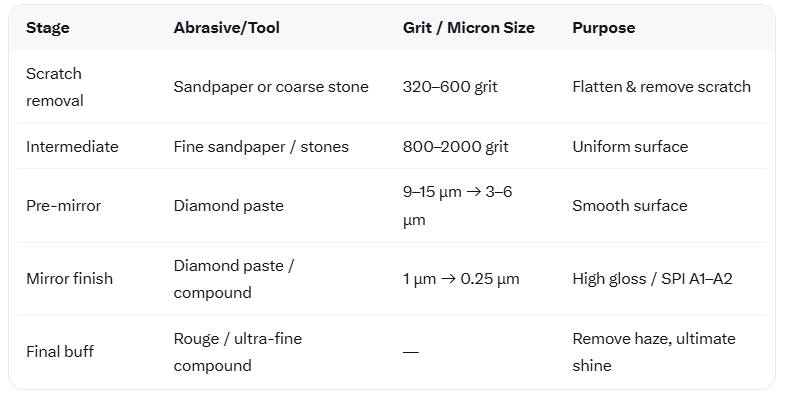
Quick Reference Grit Progression Table (Typical Mold Polishing Sequence)
Additional Tips
For very light surface scratches (e.g., from ejector pins or handling): sometimes 2000–3000 grit paper + 3 μm → 1 μm diamond is enough.
Textured molds: polishing will destroy texture → you must re-etch (acid etching) after repair.
Prevention is better: use brass/copper tools for cleaning, avoid steel brushes, use approved mold cleaners, and store molds properly.
Time estimate: light scratches — a few hours; deep scratches on large areas — 1–3 days for skilled polisher.