
Think of injection mold tool inserts as the "swappable cartridges" of the manufacturing world. Instead of machining an entire massive block of steel for every slight product variation, engineers use inserts to handle the specific geometry of the part.
Here is the breakdown of how they function and why they are used.
1. The "Plug and Play" Mechanism
A standard injection mold consists of a mold base (the heavy frame) and pockets machined into that frame. The tool insert is a smaller piece of high-quality steel or aluminum that fits precisely into those pockets.
Precision Fit: Inserts are machined to extremely tight tolerances (often within microns) to ensure that when the mold closes, there are no gaps (flash) where molten plastic can leak through.
Retention: They are typically held in place from the back of the mold plate using bolts or "cleats" so they don't move under the massive pressure of the injection cycle.
2. Primary Functions
Tool inserts aren't just for shaping the plastic; they solve several mechanical headaches:
Complex Geometry: It is much easier to machine a small, separate block of steel into a complex shape than it is to reach deep into a massive mold base with a cutting tool.
Venting: Because an insert is a separate piece of metal, the tiny microscopic gap where the insert meets the mold base actually acts as a natural vent, allowing trapped air to escape as plastic fills the cavity.
Cooling Efficiency: You can machine dedicated cooling channels directly into an insert (conformal cooling) to get water closer to the "hot spots" of the part, which speeds up production.
3. Types of Inserts
Depending on the goal, an engineer might use different types of inserts:
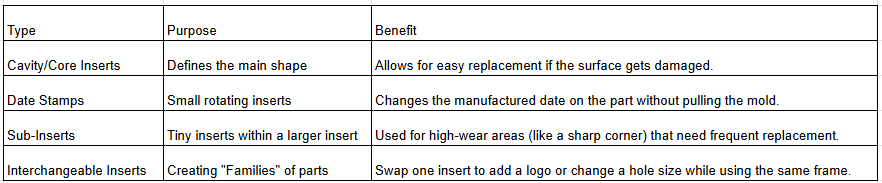
4. Thermal Management
One of the "secret" ways inserts work is through material selection.
If a specific part of a plastic product is thick and takes too long to cool, a manufacturer might use a Beryllium Copper insert in that specific spot. Copper conducts heat much faster than the surrounding stainless steel mold base, "sucking" the heat out of the plastic and dropping the cycle time significantly.
Why not just machine the whole mold from one block?
While "cutting from solid" is possible, it’s risky. If a toolmaker makes a mistake on a $50,000 single-block mold, the whole thing might be scrap. With inserts, if you break a small detail or the plastic wears down the steel over a million cycles, you only have to replace the $2,000 insert, not the entire mold.