Injection molding is the backbone of modern manufacturing, used to produce everything from LEGO bricks to car bumpers. Companies like Shenzhen Alu Rapid Prototype Precision Co., Ltd. specialize in this process, particularly focusing on rapid prototyping and high-precision production for industries like medical, automotive, and consumer electronics.
Here is the breakdown of how the process works, from raw pellets to a finished part.
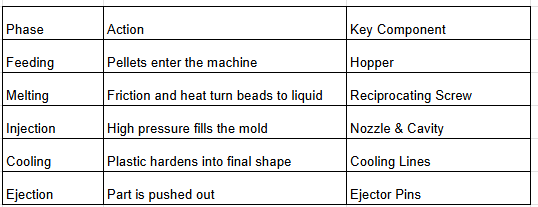
1. Clamping and Feeding
The process begins with the mold, which consists of two halves (the "A" side and "B" side). A powerful hydraulic or electric press clamps these halves together with enough force to keep them shut against the high pressure of the incoming plastic.
Meanwhile, raw plastic resin—usually in the form of small beads or pellets—is fed from a hopper into the barrel of the injection machine.
2. Plasticization (Melting)
Inside the barrel, a large reciprocating screw rotates. This does two things:
It moves the pellets forward toward the mold.
It generates frictional heat, which, combined with heater bands around the barrel, melts the plastic into a viscous liquid.
3. Injection
Once enough molten plastic has accumulated at the front of the screw, the screw acts like a plunger and moves forward rapidly. This forces the liquid plastic through a nozzle and into the mold cavity.
Pro Tip: In precision manufacturing (like the work done at Alu Rapid), controlling the injection speed and pressure is critical to ensure the plastic fills every tiny detail of the mold without creating air bubbles.
4. Cooling and Ejection
Once the cavity is full, the plastic must cool and solidify. This is often the longest part of the cycle. Cooling lines (channels with circulating water) inside the mold help regulate the temperature.
Solidification: The plastic takes the exact shape of the mold.
Opening: The clamping unit opens the two halves of the mold.
Ejection: Ejector pins push the finished part out of the mold and into a collection bin.
Why Shenzhen Alu Rapid?
In the context of a specialist firm like Shenzhen Alu Rapid, the process is often tuned for Rapid Tooling. Unlike traditional mass production which might take months to build a steel mold, we
often use:
Aluminum Molds: These dissipate heat faster (shorter cycle times) and are easier to machine, making them perfect for "bridge production" or prototypes.
High Precision: They focus on tight tolerances, ensuring that even a prototype looks and functions exactly like a final mass-produced part.
Summary Table