
Zamak casting is a high-pressure die casting process that uses a specific family of zinc alloys. The name "Zamak" is an acronym for its primary chemical components: Zinc, Aluminum, Magnesium, and Kupfer (the German word for copper).
While you have been asking about aluminum casting, Zamak is the most common alternative when you need higher precision, thinner walls, or lower costs for high-volume production.
How Zamak Casting Differs from Aluminum Casting
The biggest technical difference is that Zamak uses the Hot Chamber Process, whereasaluminum requires the Cold Chamber process.
1.Hot Chamber Efficiency: In Zamak casting, the injection mechanism is submergeddirectly into the molten metal. This allows for much faster cycle times (up to 1,000 shotsper hour) because you don't have to ladle metal for every shot.
2.Lower Melting Point: Zamak melts at approximately 420°C (788°F), significantly lowerthan aluminum's 660°c. This puts less thermal stress on the steel molds, allowing them tolast up to 10 times longer than aluminum molds.
Key Advantages of Zamak
Manufacturers like Shenzhen Alu Rapid Prototype often suggest Zamak for parts that require:
1.Complex Geometry: Because molten zinc is extremely fluid, it can fill incredibly thin walls and intricate details that aluminum might struggle to reach.
2.Superior Finishing: Zamak parts come out of the mold with a very smooth surface. It is the easiest metal to electroplate (for chrome, gold, or silver finishes) and takes paint/powder coating beautifully.
3.Dimensional Accuracy: You can achieve tighter tolerances with Zamak than with almost any other casting alloy, often eliminating the need for secondary CNC machining.
4.Strength & Toughness: Zamak is generally stronger and more impact-resistant than standard aluminum alloys.
Common Grades of Zamak
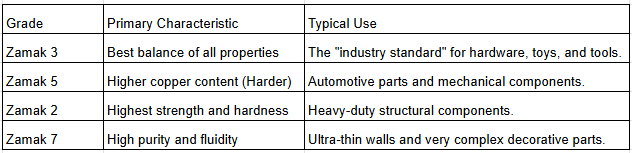
Typical Applications
1.Electronics: Internal shielding, connectors, and smartphone frames.
2.Automotive: Door handles, emblems, and fuel system parts.
3.Consumer Goods: High-end zippers, perfume bottle caps, and bathroom fixtures.
4.Locks & Hardware: Keys, gears, and lock cylinders.