What is vacuum casting silicone?
Vacuum casting with silicone (often referred to as Urethane Casting) is a highly efficient manufacturing process used to create high-quality prototypes or low-volume production parts. Based on the industrial standards utilized by firms like Shenzhen Alu Rapid Prototype Precision Co., Ltd, the process relies on a silicone mold to replicate a "master pattern."
How the Process Works
The process is favored for its ability to produce parts with production-level finishes without the massive upfront cost of steel tooling.
The Master Pattern: A high-precision master is created, usually via 3D printing (SLA/polyjet) or CNC machining. This pattern defines the final dimensions and surface texture.
Creating the Silicone Mold: The master pattern is suspended in a casting box, and liquid silicone rubber is poured around it. Once the silicone cures, it is cut open, and the master pattern is removed, leaving a perfect negative cavity.
Vacuum Casting: Resins (polyurethanes) are poured into the silicone mold. This happens inside a vacuum chamber to ensure that air bubbles are completely removed, allowing the resin to flow into every intricate detail of the mold.
Curing and Finishing: The resin cures in an oven. Once solid, the part is removed from the silicone mold, and the mold can be reused (typically for 15–20 shots).
Why Use It? (The "Alu Rapid" Context)
Companies like Shenzhen Alu Rapid Prototype utilize this method to bridge the gap between a 3D-printed prototype and full-scale injection molding.
Key Advantages:
Material Versatility: You can use resins that mimic the properties of production plastics like ABS, Polypropylene, Polycarbonate, and even transparent or rubber-like materials.
Quality: It captures textures perfectly—from high-gloss finishes to specific mold-tech textures.
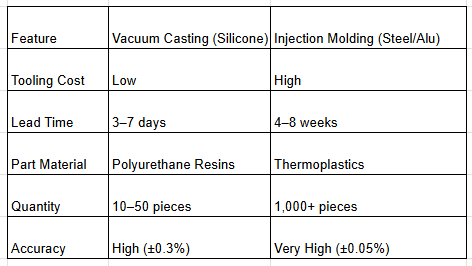
Cost-Effective: It is significantly cheaper than creating a metal mold for quantities between 10 and 50 units.
Speed: A silicone mold can be produced in a fraction of the time it takes to CNC a steel tool.
Common Applications:
Functional Testing: Testing the "snap-fit" or ergonomics of a design.
Marketing Samples: High-fidelity models for trade shows or photography.
Low-Volume Production: Small batches for specialized equipment or medical devices.
Comparison: Silicone Casting vs. Injection Molding