
Rapid tooling is a middle ground between one-off prototyping and full-scale mass production. It bridges the gap by using Additive Manufacturing (3D printing) or other quick-turn processes to create molds, dies, or patterns needed to produce parts.
Think of it as the "fast-track" version of traditional tooling. Instead of waiting months for a hardened steel mold, you get a functional tool in days or weeks.
How It Works
The goal is to produce a "bridge tool" that allows you to manufacture anywhere from 10 to 1,000+ parts in the final production material (like injection-molded plastic) before investing in permanent, expensive equipment.
The Two Main Approaches
Indirect Tooling: You 3D print a master pattern (usually out of resin or wax) and then use that pattern to create a mold out of silicone or epoxy.
Direct Tooling: You use a 3D printer or CNC machine to create the actual mold cavity itself. For example, using Metal 3D printing to create an insert for an injection molding machine.
Why Use Rapid Tooling?
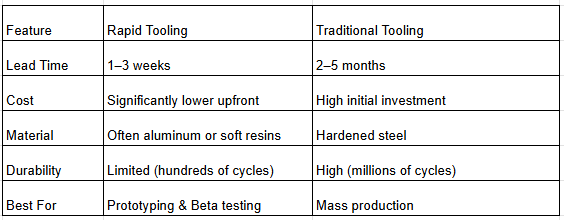
Key Benefits
Speed to Market: You can get "real" parts into the hands of testers or early customers while the factory is still building the permanent assembly line.
Functional Testing: Since you are using the actual production material (unlike a standard 3D print), you can perform true stress, heat, and chemical tests.
Design Flexibility: If you find a flaw in the design during the "rapid" phase, it’s much cheaper to tweak a 3D-printed mold than to re-cut a steel one.
Keep in mind: Rapid tools aren't meant to last forever. They are often made of "softer" materials like aluminum or 3D-printed photopolymers, which will eventually wear down under the heat and pressure of repeated use.