
Moving from a 2D sketch to a 3D prototype is like switching from a map to a GPS—it doesn't just show you where you're going; it gives you the depth, context, and real-time feedback you need to get there without crashing.
Whether you're using 3D printing (additive manufacturing) or digital CAD modeling, the benefits touch every part of the development cycle.
1. Visual and Spatial Clarity
The most immediate benefit is the elimination of "guesswork." A 3D prototype allows stakeholders to see the product from every angle, understanding the scale and ergonomics in a way a flat drawing never could.
Physical Interaction: You can hold it, flip it, and test how it fits in a human hand.
Assembly Check: You can see how complex internal parts fit together before committing to expensive tooling.
2. Rapid Iteration and Speed to Market
In the old days, changing a design meant weeks of re-tooling. Now, it’s often just a few clicks in a software program and a few hours on a 3D printer.
Fail Fast, Learn Faster: You can test five different versions of a hinge in a single day.
Reduced Lead Times: By catching design flaws early, you avoid the "back to the drawing board" phase during mass production, which can save months of time.
3. Significant Cost Savings
While the software and hardware have an upfront cost, 3D prototyping is a massive money-saver in the long run.
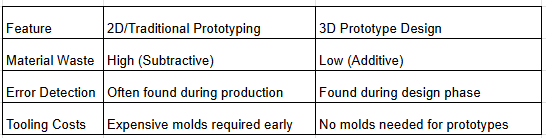
4. Functional Testing and Performance
Modern 3D prototyping isn't just about looks; it's about physics. Many 3D-printed materials can mimic the strength, flexibility, or heat resistance of the final production material.
Airflow & Hydrodynamics: Testing how a shape moves through air or water.
Stress Analysis: Using Finite Element Analysis (FEA) within 3D software to predict where a part might break under pressure.
5. Better Stakeholder Communication
It is much easier to sell an idea to a client or an investor when they can touch a physical object or see a high-fidelity 3D render. It builds confidence and ensures everyone is literally looking at the same thing, reducing "expectation gaps."
Pro Tip: Using 3D prototypes for user testing can provide much more accurate feedback than showing users a picture. People interact with physical objects differently than they do with images.