What is a throwaway prototype?
A throwaway prototype (also called rapid prototyping or close-ended prototyping) is a quick, disposable model created during the early stages of product or software development. The key characteristic is that it is intentionally discarded ("thrown away") after serving its purpose — it is never intended to become part of the final product or to evolve into the finished system.
Main Purpose
The goal is to:Quickly explore ideas
Clarify unclear or vague requirements
Test concepts
Gather early user/stakeholder feedback
Reduce risk by validating assumptions before investing heavily in development
How It Works (Typical Flow)
Gather initial (often incomplete/vague) requirements
Quickly build a simple prototype (can be paper sketches, wireframes, mockups, or basic clickable/digital versions)
Show it to users/stakeholders → collect feedback
Refine or create new throwaway prototypes if needed (often multiple versions are made)
Once enough understanding is gained → discard the prototype(s)
Use the knowledge to write proper requirements/specifications
Build the real system from scratch using standard development practices
Common Forms of Throwaway Prototypes
Paper prototypes / sketches
Wireframes
Low-fidelity mockups
Quick HTML/CSS/clickable demos
Basic UI simulations (often built in hours or days)
Advantages
Very fast and inexpensive to create
Allows experimentation with multiple different ideas/concepts
Great for unclear/vague requirements
Early risk reduction
Better user involvement early on
Avoids sinking too much time into wrong directions
Disadvantages
Time spent building it is "lost" (not reused in final code)
Risk of developers or stakeholders becoming attached to it
Can give false sense of progress if misunderstood
Needs clear communication that "this will be thrown away"
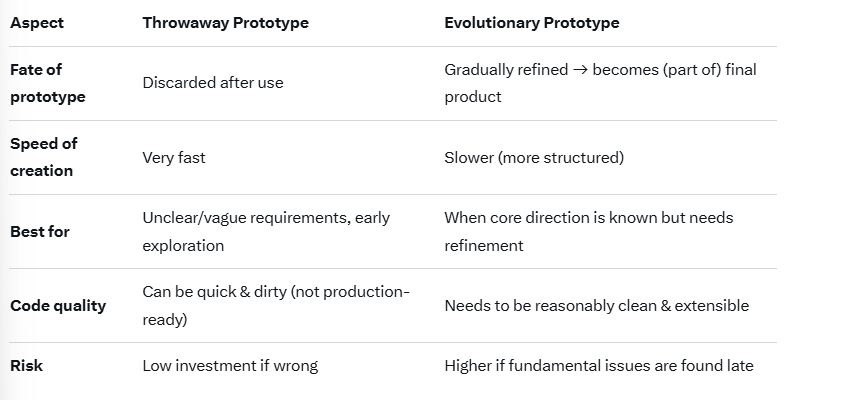
Throwaway vs Evolutionary Prototyping (most common comparison)