
What are bridge tools?
Bridge tools (most commonly referred to as bridge tooling in the manufacturing world) are a type of transitional tooling used in injection molding and related processes. They literally "bridge" the gap between prototyping and full-scale production tooling.
What Bridge Tooling Actually Is?
Bridge tooling is a cost-effective, faster-to-build mold (typically made from aluminum, pre-hardened steel like P20, or softer materials) that produces real injection-molded parts in production-intent materials — but in lower volumes (usually hundreds to a few tens of thousands of shots) — while the expensive, long-lead-time final production steel mold is still being designed, finalized, or manufactured.
It sits in the sweet spot between:
Prototype tooling → very cheap/quick but limited materials, lower quality, few shots (often<100–500)
Production tooling → hardened steel, very expensive (often $50k–$500k+), takes months, but lasts 100,000–millions of shots
When companies typically use bridge tools
Here are the most common situations:
Need production-like parts (right material, tolerances, surface finish) for market testing, early customer samples, or trade shows
Want to start selling / fulfilling initial orders while waiting 3–12+ months for production tooling
Design still has some risk of changes (you don't want to cut expensive steel yet)
Forecasted volumes are uncertain at first
Need to bridge cash flow — much cheaper than full production tooling
Ramp-up production during the early commercial phase.
Quick Comparison Table
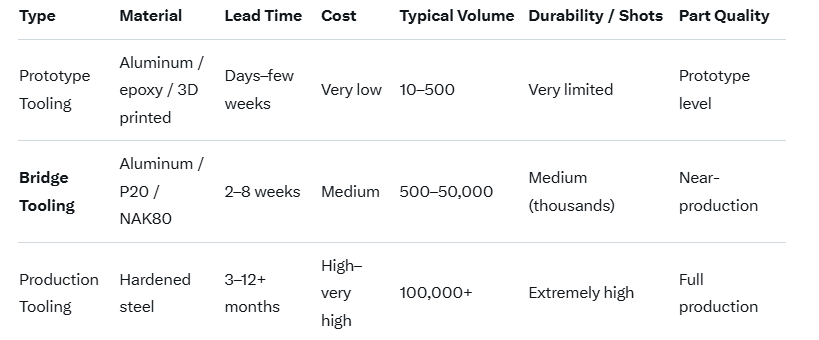
Bridge tooling is especially popular in product development for consumer electronics, automotive parts, medical devices, and any product where getting real molded parts to market quickly (and relatively affordably) creates a big competitive advantage.