
What is bridge tooling?
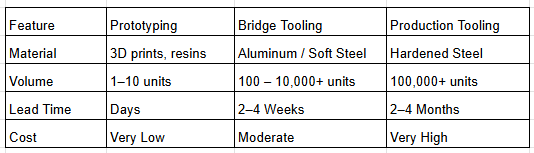
In manufacturing, bridge tooling (also called rapid tooling or development tooling) is the process of creating temporary molds to produce a limited number of parts while waiting for permanent, high-volume "production" tools to be finished.It acts as a literal "bridge" between the prototyping phase and full-scale mass production.
Why is Bridge Tooling Necessary?
When a product design is finalized, manufacturing high-quality steel molds for mass production can take anywhere from 8 to 16 weeks. Bridge tooling allows a company to start selling or testing the product almost immediately (often within 2 to 4 weeks).
Key Benefits
Speed to Market: You can launch your product and begin generating revenue while the "forever" tools are still being machined.
Design Validation: Since bridge tools often use the actual production-grade plastic, you can perform final safety and stress tests that 3D-printed prototypes can't handle.
Market Testing: It allows for a "pilot run." If the market hates a feature, you can change the design before spending $50k+ on permanent steel tooling.
Troubleshooting: It helps identify manufacturing "kinks" (like where a part might shrink or warp) in a low-risk environment.
Common Materials
Because bridge tools don't need to last for millions of cycles, they are made from "softer" metals that are much faster to CNC machine:
Aluminum (7075 grade): The most common choice. It dissipates heat quickly and is easy to cut.
P20 Steel: A semi-hard steel used when the part volume is on the higher end (e.g., 50,000 units).
When should you use it?
You should consider bridge tooling if:
Your final production tools are months away, but you have customers waiting now.
You need 500 units for a trade show or clinical trial.
The design is "95% stable" but might need one final tweak based on early user feedback.