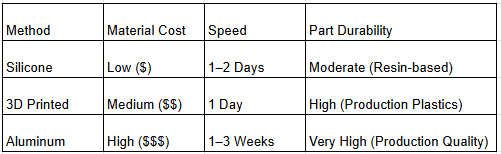
Creating a prototype mold is a bridge between a digital design and mass production. The "best" way to do it depends entirely on your budget and how many parts you need.
Here is a breakdown of the three most common methods used by engineers and hobbyists today.
1. Silicone RTV Molding (Soft Tooling)
Best for: 10–50 parts, complex geometries, and "final feel" prototypes. This is the most accessible DIY method. You create a "master" (usually 3D printed) and pour liquid silicone around it to create a flexible mold.
Step 1: Create the Master. 3D print your part (SLA printing is best for smooth surfaces) or hand-sculpt it.
Step 2: Build a Mold Box. Place your master inside a small container. Ensure there is at least 1cm of space on all sides.
Step 3: Pour the Silicone. Mix RTV (Room Temperature Vulcanizing) silicone and pour it slowly into a corner of the box to minimize air bubbles.
Step 4: Cut & Cast. Once cured (12–24 hours), cut the silicone to remove the master. You can now pour resins (urethane or epoxy) into this cavity to "cast" your prototype parts.
2. 3D Printed Injection Molds
Best for: 50–100 parts, testing actual production plastics (like ABS or PP). Instead of printing the part, you 3D print the mold itself using high-temperature resins.
Design: In your CAD software, create a block and subtract your part from it to create the cavity. You must include draft angles (slight tapers of 1–2°) so the part can slide out.
Material: Use specialized "High Temp" or "Rigid 10K" resins that can withstand the heat and pressure of an injection molding machine.
Process: The printed mold is placed into a metal frame (to prevent cracking) and injected with molten plastic.
3. Aluminum CNC Machining (Rapid Tooling)
Best for: 100–5,000 parts, high precision, and bridge production. This is the "pro" route. While steel molds are for millions of parts, aluminum is cheaper and faster to carve.
Process: A CNC mill carves the mold out of a solid block of aluminum.
Advantages: Excellent heat dissipation (faster cooling) and much higher durability than silicone or 3D prints.
Cost: Usually requires a professional shop (e.g., Protolabs or Xometry) and costs between $1,500 and $5,000 depending on complexity.
Comparison at a Glance