
When comparing stamped steel and die-cast steel, the most important thing to know is that "die-cast steel" is a bit of a misnomer. In the manufacturing world, true die casting is almost exclusively reserved for non-ferrous metals (like aluminum or zinc) because steel's melting point is so high it would melt the molds.
If you are looking at a 3D steel part that isn't stamped, it is likely cast steel (poured into sand molds) rather than "die-cast." Here are the primary differences between stamped and cast steel parts.
1. Manufacturing Process
Stamped Steel: A "cold-forming" process. A flat sheet or coil of steel is placed into a press, where a heavy die strikes it to cut, bend, or stretch it into a 3D shape. Think of it like a heavy-duty industrial cookie cutter.
Cast Steel: A "hot-forming" process. Steel is heated until it is completely liquid (molten) and then poured into a mold cavity to solidify.
2. Geometry and Complexity
Stamped Steel: Limited to shapes that can be formed from a flat sheet. You generally get a uniform wall thickness. To make complex shapes, you often have to weld multiple stamped parts together.
Cast Steel: Offers immense design freedom. You can create solid blocks, vary the thickness throughout the part, and include internal cavities or intricate 3D features that a stamping press simply cannot reach.
3. Physical Characteristics
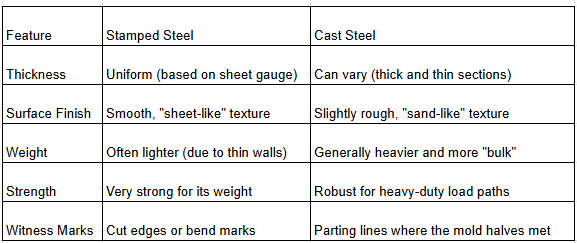
Which one should you choose?
Choose Stamped Steel if you need high-volume, lightweight, and cost-effective parts like brackets, car body panels, or simple enclosures.
Choose Cast Steel if you need a single, heavy-duty component with a complex shape that must withstand massive structural loads, like heavy machinery gears or engine blocks.