How to Make Aluminum Die Casting Prototypes?
Creating an aluminum die-cast prototype is a challenge because true die casting requires expensive, permanent steel tools that are usually not cost-effective for just a few parts. To solve this, engineers use four primary methods depending on whether they need "production-identical" properties or just a visual model.
1. The "True" Prototype: Single-Cavity Unit Dies
If you need 100% accurate testing (functional, thermal, and structural), you must use actual pressure.
The Process: Instead of building a massive multi-cavity production tool, a "unit die" is used. This is a smaller, simplified steel insert (often made of softer P20 or H13 steel) that fits into a standard master mold base.
Best for: 50–500 parts. It uses the exact alloy and pressure as the final run.
Lead Time: 2–4 weeks.
2. The Speed King: CNC Machining ("Hog-outs")
Many "die cast" prototypes aren't cast at all; they are carved from a solid block of aluminum.
The Process: A CNC machine removes material from a billet of aluminum (typically 6061 or a casting-simulated alloy).
Best for: 1–10 parts. It is the fastest way to get a metal part in hand.
Limitation: It cannot perfectly replicate the "skin" or internal porosity of a cast part, which may affect fatigue testing.
3. The Batch Solution: Plaster Mold Casting (RPM)
This is often called the "Rubber Plaster Mold" (RPM) process and is the most common way to simulate a die casting without the steel tool cost.
The Process: A "master" is made (usually via 3D printing/SLA). A silicone rubber mold is created from the master. A liquid plaster slurry is poured into the rubber mold to create a plaster mold.
Molten aluminum is poured into the plaster mold (often under a vacuum to help it flow into thin walls).
Best for: 10–100 parts. It mimics the thin walls of die casting very well.
4. The Digital Alternative: 3D Printing (DMLS)
Direct Metal Laser Sintering (DMLS) uses a laser to melt aluminum powder layer by layer.
The Process: The machine builds the part directly from a 3D file.
Best for: Highly complex geometries that are impossible to machine or cast.
Lead Time: 2–5 days.
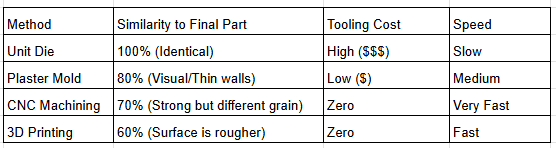
Summary: Which one should you choose?