
Both permanent mold casting and die casting are metal casting processes that use reusable metal molds (dies) rather than expendable sand molds. Because the molds are made of durable metals like steel or cast iron, they can be used thousands of times, making them ideal for high-volume production.
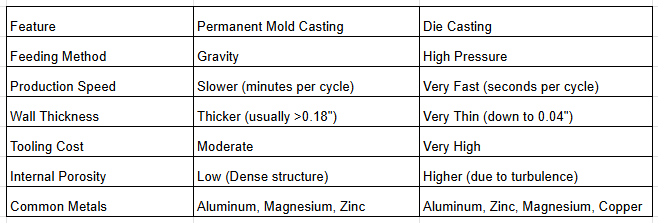
The primary difference between the two lies in how the molten metal enters the mold: permanent mold casting uses gravity, while die casting uses high pressure.
1. Permanent Mold Casting
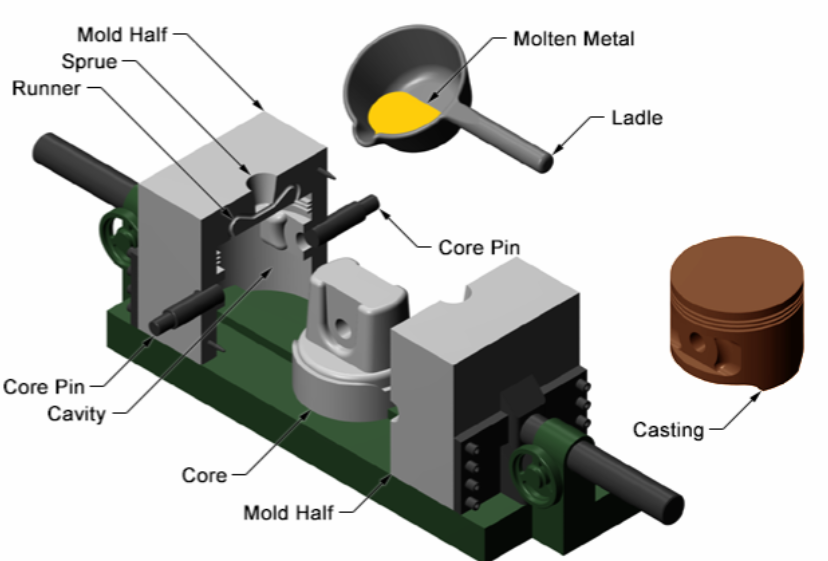
Often called Gravity Die Casting, this process relies on the weight of the molten metal itself to fill the mold.
a.The Process: Molten metal is poured from a ladle into a runner system. To ensure the mold fills completely without air pockets, the mold is often tilted during the pour (tilt-pour casting).
b.Best For: Medium-volume production (500 to 50,000 parts). It is commonly used for larger, thicker-walled parts like automotive pistons, cylinder heads, and gear housings.
c.Key Advantage: Since the metal isn't forced in under high pressure, there is less turbulence, resulting in lower porosity (trapped air). This makes the parts stronger and "pressure-tight."
2. Die Casting
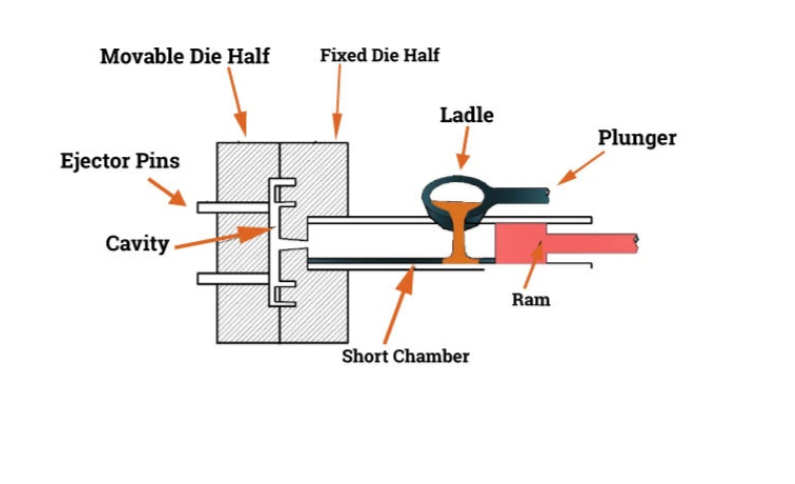
Die casting is essentially the metal version of plastic injection molding. It uses high-pressure machinery to force metal into the mold at high speeds.
a.The Process: A hydraulic piston rams molten metal into the die at pressures ranging from 1,000 to 20,000psi. This pressure is maintained until the metal solidifies.
b.Best For: High-volume production (10,000+ parts). It is the go-to for small to medium intricate parts like "Hot Wheels" cars, smartphone frames, and engine components.
c.Key Advantage: It can produce thinner walls and much more complex geometries than gravity-fed methods. It also offers the fastest cycle times and the smoothest surface finishes.
Key Differences at a Glance
Choosing Between Them
1.Choose Permanent Mold if you need high structural integrity, thicker walls, or are only making a few thousand parts.
2.Choose Die Casting if you need millions of small, complex parts with very thin walls and a "ready-to-use" surface finish.