
Tilt die casting, also known as tilt pour permanent mold casting or gravity tilt casting, is a variation of permanent mold (gravity die) casting. It uses reusable metal molds (typically steel or cast iron) and relies on gravity, with controlled tilting to fill the mold smoothly and reduce turbulence, oxides, and defects compared to static pouring.
Process of Pouring Metal into the Mold
The key feature is controlled tilting to allow molten metal (often aluminum or zinc-aluminum alloys) to flow gently into the mold cavity:
1.Initial Position — The mold starts in a tilted or near-horizontal position, with a pouring basin (pour cup or bowl) at the highest point, connected to the gating system.
2.Pouring the Metal — An operator (or robot) pours molten metal directly into the pouring basin while the mold is in this tilted position. No high pressure is used—it's gravity-assisted.
3.Tilting the Mold — The entire mold assembly slowly tilts (often 90 degrees) to a vertical or horizontal solidification position. This controlled rotation allows the metal to flow smoothly down the gating system into the mold cavity under gravity, with minimal turbulence. The slow tilt ensures the metal front advances calmly, pushing air out and reducing entrapment of oxides or gas.
4.Filling and Solidification — As tilting progresses, the cavity fills progressively from the bottom up. Once full, the mold remains in position for the metal to solidify.
5.Ejection — After cooling, the mold opens, and the casting is ejected. The machine returns to the starting position for the next cycle.
This method contrasts with static gravity pouring (metal dumped directly into a stationary mold, causing more splash) and is ideal for parts needing high density, good surface finish, and structural integrity (e.g., wheels, pistons, housings).
Visual Illustrations
Here are relevant diagrams and photos showing the tilt pour process and machines:
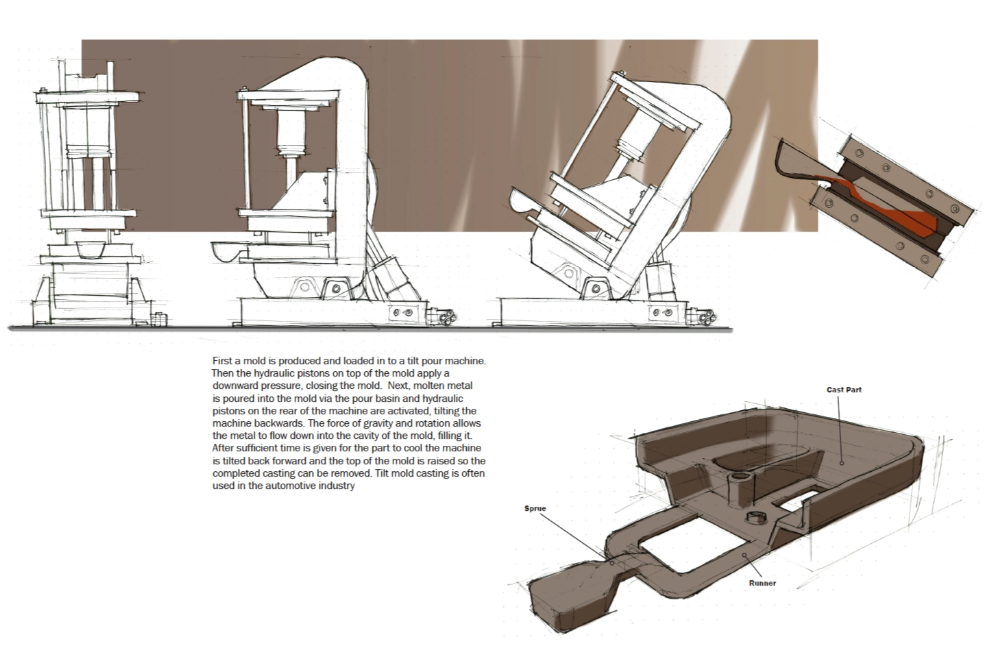
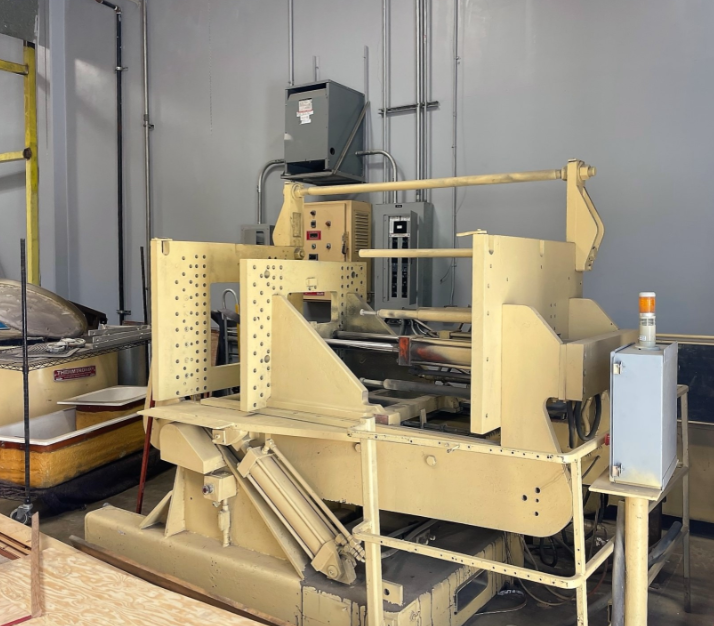
These images depict mold tilting sequences, pouring basins, and actual tilt pour machines in action.