Creating die-cast molds (also known as dies) is a highly specialized engineering process. Unlike sand casting, which uses a one-time mold, die casting uses permanent, high-strength metal molds capable of producing thousands of identical parts under extreme pressure.
Here is the step-by-step breakdown of how these molds are manufactured.
1. Design and Engineering (CAD/CAE)
Before any metal is cut, engineers create a digital 3D model. This is the most critical phase because errors here lead to expensive failures later.
1.Parting Line: Determining where the two halves of the mold will meet.
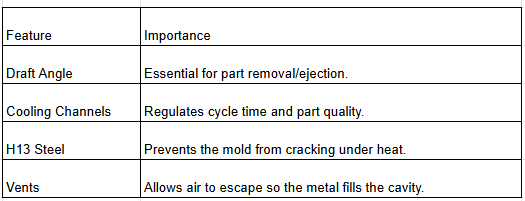
2.Draft Angles: Adding a slight taper (usually 1° to 2°) to the walls so the part can slide out without sticking.
3.Gating System: Designing the "plumbing" (runners and gates) that directs molten metal into the cavity.
4.Simulation: Using software to simulate the metal flow to predict "cold shuts" (where metal cools too fast) or air pockets.
2. Material Selection
Die molds must withstand "thermal shock"—the constant cycling between room temperature and molten metal (up to 700°C for aluminum).
1.H13 Tool Steel: The industry standard for aluminum and magnesium due to its incredible heat resistance.
2.P20 or 420 Stainless: Often used for zinc casting or when corrosion resistance is a priority.
3. The Machining Process
Once the design is finalized, the mold is carved out of solid blocks of steel using several precision methods:
1.Rough CNC Machining: High-speed milling machines remove the bulk of the steel to get the general shape.
2.EDM (Electrical Discharge Machining): For deep, thin, or intricate details that a drill bit can't reach, a "sinker" EDM uses an electrode to burn the shape into the steel using electricity.
3.Drilling Cooling Lines: Deep holes are drilled through the mold blocks to allow water or oil to circulate, regulating the temperature during production.
4. Heat Treatment
After the rough shape is machined, the steel is "soft." To handle the pressure of the die-casting machine (up to 25,000 PSI), the mold must be hardened.
1.The steel is heated in a vacuum furnace and then "quenched" (cooled rapidly).
2.This brings the mold to a hardness of roughly 44–48 HRC (Rockwell Scale).
5. Finishing and Assembly
Hardening the steel can cause tiny dimensional shifts, so a final round of "finish machining" and polishing occurs.
1.High Polish: Cavities are polished to a mirror finish to ensure the cast parts look good and release easily.
2.Ejector Pins: Holes are drilled for pins that will physically push the finished part out of the mold.
3.Fitting: The two halves are "blued" (coated with dye) and pressed together to ensure they seal perfectly with no gaps.
6. Mold Trial ("First Shot")
The finished mold is mounted on a die-casting machine for a trial run.
1.Sampling: The first few parts are inspected for dimensions and surface quality.
2.Debugging: If the part has "flash" (excess metal leaking at the seams) or air bubbles, the mold is taken back to the shop for fine-tuning.
Key Summary Table