
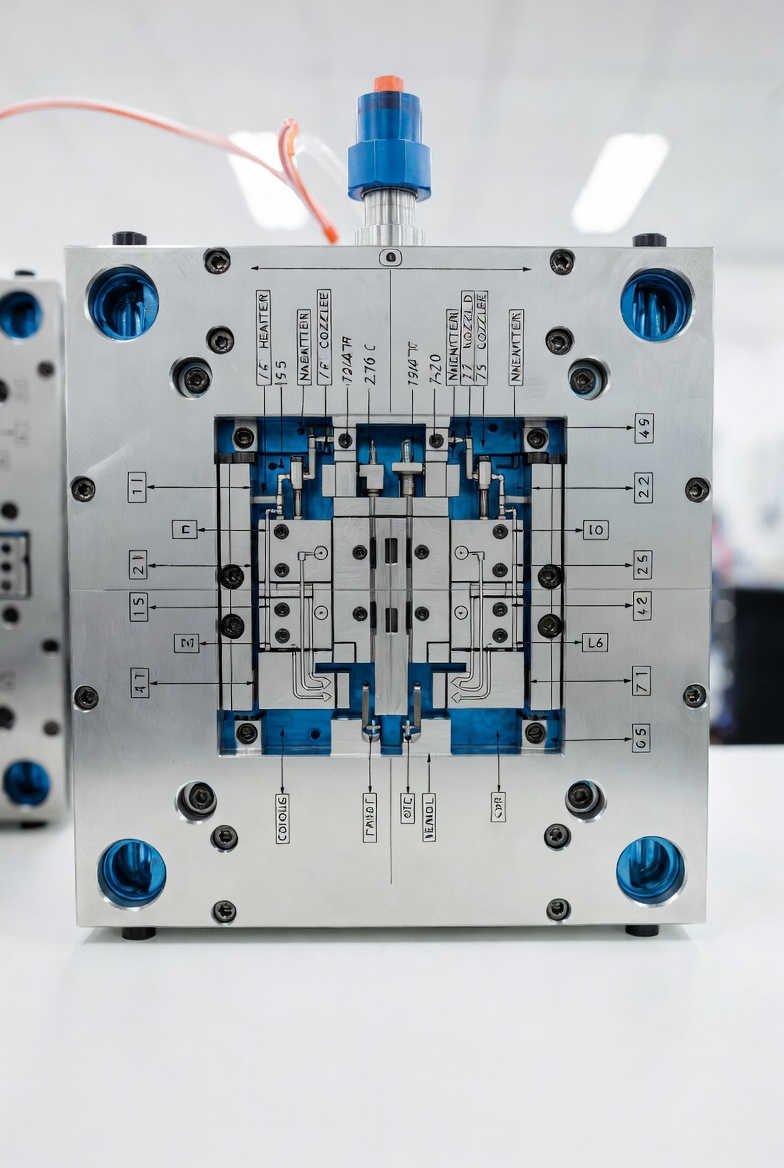
Injection molds are not defined by a single category; rather, they are classified by their construction, how they handle material (feeding systems), and their production purpose.
Here is a breakdown of the primary types of injection molds used in manufacturing today:
1. Classification by Mold Structure (Plates)
The physical architecture of the mold determines how parts and waste (runners) are removed.
A.Two-Plate Mold: The most common and simplest type. It has one parting line where the mold halves separate to eject the part.
B.Three-Plate Mold: Features two parting lines and an extra "stripper plate." This allows the runner system to be separated and ejected automatically from the part, which is ideal for high-volume automation.
C.Stack Mold: Imagine multiple molds stacked on top of each other. This design allows for double (or more) the production output in a single cycle without requiring a significantly larger machine.
2. Classification by Feeding (Runner) System
This refers to how the molten plastic travels from the machine's nozzle to the part cavity.
A.Cold Runner Mold: The plastic in the channels (runners) cools and solidifies along with the part. This creates "runner waste" that must be trimmed off and recycled.
B.Hot Runner Mold: The channels are internally heated, keeping the plastic molten at all times. Only the part itself solidifies, resulting in zero waste, faster cycle times, and better part quality.
C.Insulated Runner Mold: A hybrid approach where the plastic itself acts as an insulator to keep the inner core of the runner molten.
3. Classification by Number of Cavities
A.Single-Cavity Mold: Produces one part per cycle. Used for large parts or low-volume prototypes.
B.Multi-Cavity Mold: Produces multiple identical parts in one cycle. Essential for mass production (e.g., bottle caps).
C.Family Mold: Produces different parts of the same assembly (like the top and bottom of a remote control) in a single cycle.
4. Special Function Molds
Some parts have complex geometries that require specialized mechanical actions within the mold:

5. SPI Mold Classifications
The Society of the Plastics Industry (SPI) classifies molds based on their expected lifespan (cycles):
Class 101: Extremely high volume (1,000,000+ cycles); built with hardened tool steel.
Class 103: Medium volume (under 500,000 cycles); most common for general production.
Class 105: Prototype only (under 500cycles); often made of aluminum or soft alloys