
Designing an injection mold for plastic parts is a complex process that combines part design principles (Design for Manufacturability or DFM) with mold engineering. The goal is to create a tool that produces high-quality parts efficiently, with minimal defects, while controlling costs.
Step-by-Step Process to Design an Injection Mold
1.Design the Plastic Part with Moldability in Mind
Start with the part geometry. Use CAD software to model it, adhering to injection molding best practices. Key principles include:
1.Uniform wall thickness — Aim for 2-4 mm (0.080-0.160 inches) typically; thinner for small parts, thicker for structural ones. Avoid variations >25% to prevent sink marks, warping, or voids.
2.Draft angles — Add 1-2° per side (more for textured surfaces) to ease ejection.
3.Radii and fillets — Use generous radii (at least 0.5x wall thickness) on corners to improve flow and reduce stress concentrations. Avoid sharp corners.
4.Ribs and bosses — Add for strength, but keep ribs<60% of wall thickness to avoid sinks.
5.Avoid or minimize undercuts — These require side actions (slides/lifters), increasing cost. Use pass-through features or flexible materials if possible.
6.Account for shrinkage (0.4-2% typically, material-dependent).
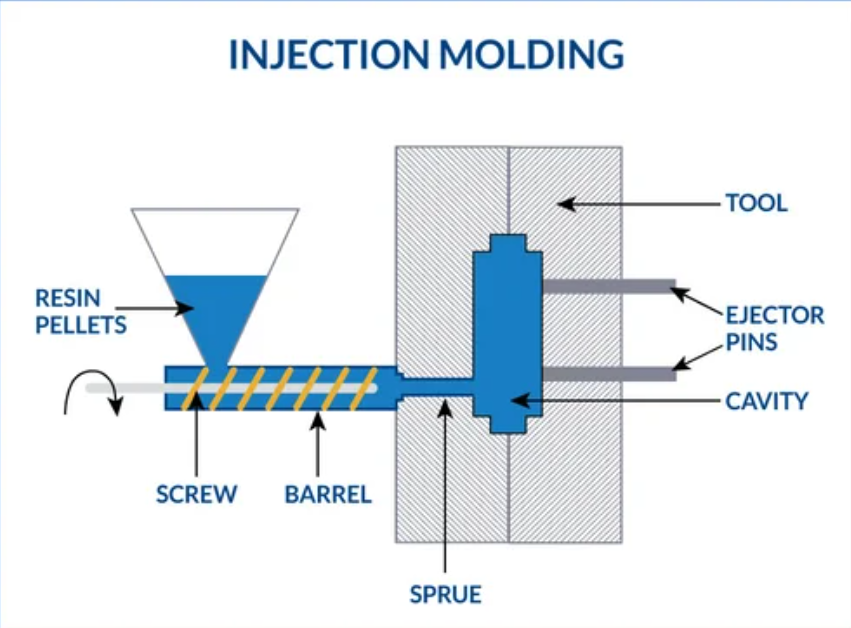
These schematics illustrate the basic injection molding cycle: clamping, injection, cooling, and ejection.
2.Determine Mold Type and Configuration
1.Two-plate vs. three-plate mold → Two-plate is simpler/cheaper; three-plate for automatic runner separation.
2.Number of cavities → Single for prototypes/low volume; multi-cavity for high production (balance flow).
3.Parting line → Place where mold halves separate—ideally flat or on non-cosmetic edges.
4.Core and cavity sides → Cavity (A-side) forms the exterior/show surface; core (B-side) forms the interior.
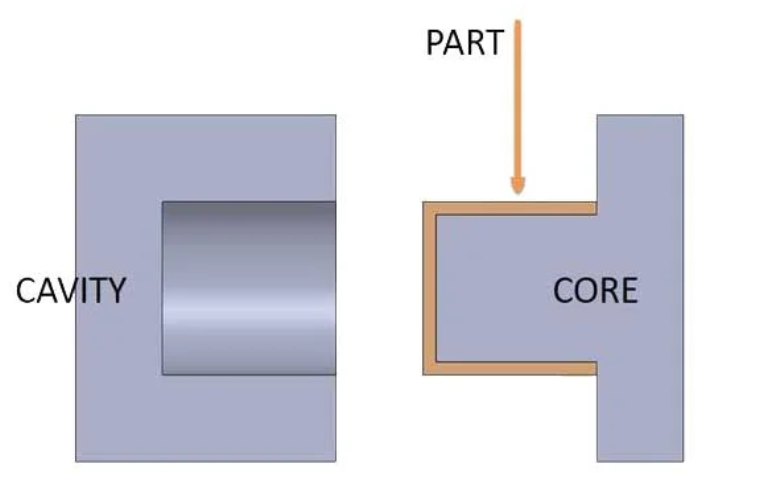
3.Design the Mold Components
Use mold design software (e.g., Moldflow for simulation). Key elements:
1.Gating system — Sprue, runners, gates (edge, pin, submarine). Gate location affects flow, weld lines, and venting. Place gates for balanced fill.
2.Cooling system — Channels for uniform cooling (critical to cycle time and quality).
3.Ejection system — Pins, sleeves, or strips to push part out without damage.
4.Venting — Thin gaps to allow air escape, preventing burns or shorts.
5.Slides/lifters — For undercuts.
6.Material selection — Steel (P20, H13) for production; aluminum for prototypes.
4.Simulate and Optimize
Run mold flow analysis to predict fill time, pressure, cooling, warpage, and defects. Adjust gate locations, cooling, or part design as needed.
5.Manufacture, Test, and Iterate
Machine the mold (CNC, EDM). Produce samples, measure dimensions (accounting for shrinkage), check for defects, and tweak (e.g., steel-safe areas left for adjustments).
Key Best Practices and Common Pitfalls
1.Prioritize straight-pull designs to minimize complexity/cost.
2.Select material early (e.g., ABS flows well; filled resins shrink less).
3.For high volume, invest in robust molds; for low volume, consider 3D-printed molds.
4.Common defects to avoid: Sink marks (thick sections), weld lines (poor gate placement), flash (poor clamping).