
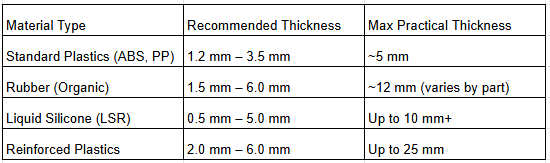
In injection molding, thickness is less about a "maximum limit" and more about practicality and cost. While you can mold very thick parts, it becomes exponentially more difficult and expensive as thickness increases.
General Thickness Guidelines
The "sweet spot" for most injection-molded parts (both plastic and rubber) is between 2 mm and 4 mm (0.08" to 0.16")
The "Wall" You Hit with Thickness
As parts get thicker, three major problems occur that usually make designers choose a different method:
1. Cycle Time (The Cost Killer)
In plastic molding, the part must cool before it can be ejected. In rubber molding, the part must "cook" (cure) all the way through.
Heat Transfer: Materials are poor conductors of heat. Doubling the thickness doesn't just double the time; it can quadruple it.
A 3 mm part might take 30 seconds to mold, while a 12 mm part could take several minutes. Since you pay for the machine by the hour, thick parts are very expensive.
2. Physical Defects
Thick sections are prone to internal "stress" as they solidify.
Sink Marks: The outer skin cools first, and as the inside cools and shrinks, it pulls the surface inward, creating a "dent."
Voids: If the outer skin is too rigid to pull inward, the shrinking center creates a vacuum bubble or "void" inside the part, weakening it.
Warping: Different thicknesses cool at different rates, causing the part to twist or bow like a piece of drying wood.
How to Handle "Required" Thickness
If your part needs to be strong or heavy, engineers rarely just make the walls thicker. Instead, they use Coring and Ribbing.
Coring out: Instead of a solid 20 mm block, you design a 3 mm shell with a hollow center.
Ribs: To add strength back to that hollow shell, you add thin internal support walls (ribs).
Rule of Thumb: Ribs should usually be 50% to 70% of the thickness of the main wall to prevent sink marks where they join.
Exceptions
Flow Molding: Some specialized processes can mold parts up to 100 mm (4 inches) thick, but these are rare and have cycle times lasting hours.
Small Parts: If the overall part is tiny (like a rubber stopper), high thickness is much easier to manage than in a large housing or panel