
Pure aluminum die casting is a specialized manufacturing process used to produce parts from high-purity aluminum (typically 99.5% to 99.7% aluminum), rather than the standard aluminum-silicon alloys (like A380 or ADC12) commonly used in the industry.
While standard alloys are designed for easy casting, "pure" aluminum is chosen for its superior physical properties, though it is significantly more difficult to process.
1. Why use Pure Aluminum? (Key Advantages)
The primary reason engineers choose pure aluminum over alloys is to achieve specific performance metrics:
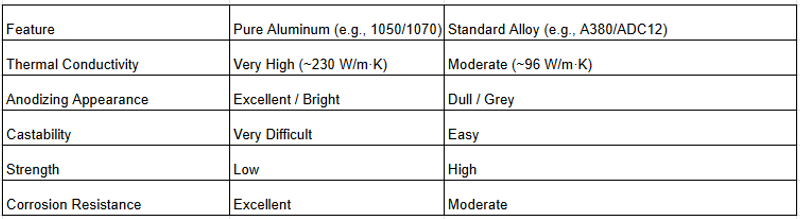
A.Thermal Conductivity: Pure aluminum has a thermal conductivity of approximately $230 \text{ W/(m·K)}$, whereas standard die-casting alloys like ADC12 are around $96 \text{ W/(m·K)}$. This makes it ideal for heat dissipation.
B.Electrical Conductivity: It offers excellent electrical conductivity (around 60% IACS), making it suitable for electrical connectors and busbars.
C.Anodizing Quality: Alloys containing silicon often turn gray or splotchy when anodized. Pure aluminum accepts decorative and hard-coat anodizing beautifully, allowing for vibrant colors and high-end surface finishes.
D.Corrosion Resistance: Without the copper or silicon found in alloys, pure aluminum has much higher natural resistance to corrosion.
2. The Technical Challenges
Casting pure aluminum is notoriously difficult for several reasons:
A.High Melting Point: Pure aluminum melts at approximately 660°C, which is higher than most alloys. This increases wear and tear on the casting molds (dies).
B.Poor Fluidity: Silicon is usually added to aluminum to make it flow like "water" into complex molds. Pure aluminum is "sluggish" and viscous, making it hard to fill thin walls or intricate details.
C.Hot Cracking: Pure aluminum has a high shrinkage rate as it cools, which often leads to "hot tears" or cracks in the finished part.
D.Soldering to the Die: Pure aluminum has a high affinity for iron. Without alloying elements to prevent it, the molten aluminum tends to "weld" or stick to the steel mold, ruining the part and the tool.
3. Applications
Because of the cost and difficulty, pure aluminum die casting is reserved for high-performance or high-aesthetic components:
A.5G Base Stations & LED Lighting: For high-efficiency heat sinks that require maximum thermal transfer.
B.Consumer Electronics: High-end laptop frames or camera bodies that require a specific anodized "metallic" feel.
C.Electric Vehicles (EVs): Battery cold plates and high-voltage electrical components.
D.High-End Cookware: Where superior heat distribution and food-safe surfaces are required.
4. Comparison: Pure Aluminum vs. Common Alloys
5. Solutions by Companies like Alu Rapid Prototype
Specialized manufacturers (like the one you mentioned, Alu Rapid Prototype Precision Co., Ltd.) often use vacuum die casting or proprietary mold coatings to overcome the fluidity and sticking issues of pure aluminum. These techniques allow them to produce thin-walled, complex parts that were previously thought impossible to cast with high-purity metal.