
High-pressure die casting (HPDC) is a highly efficient metal casting process used to produce complex, high-precision parts in large volumes. It involves forcing molten metal under high pressure (typically 1,500–25,000 psi or 10–175 MPa) into a reusable steel mold (called a die), where it rapidly solidifies into a near-net-shape component.
How the HPDC Process Works
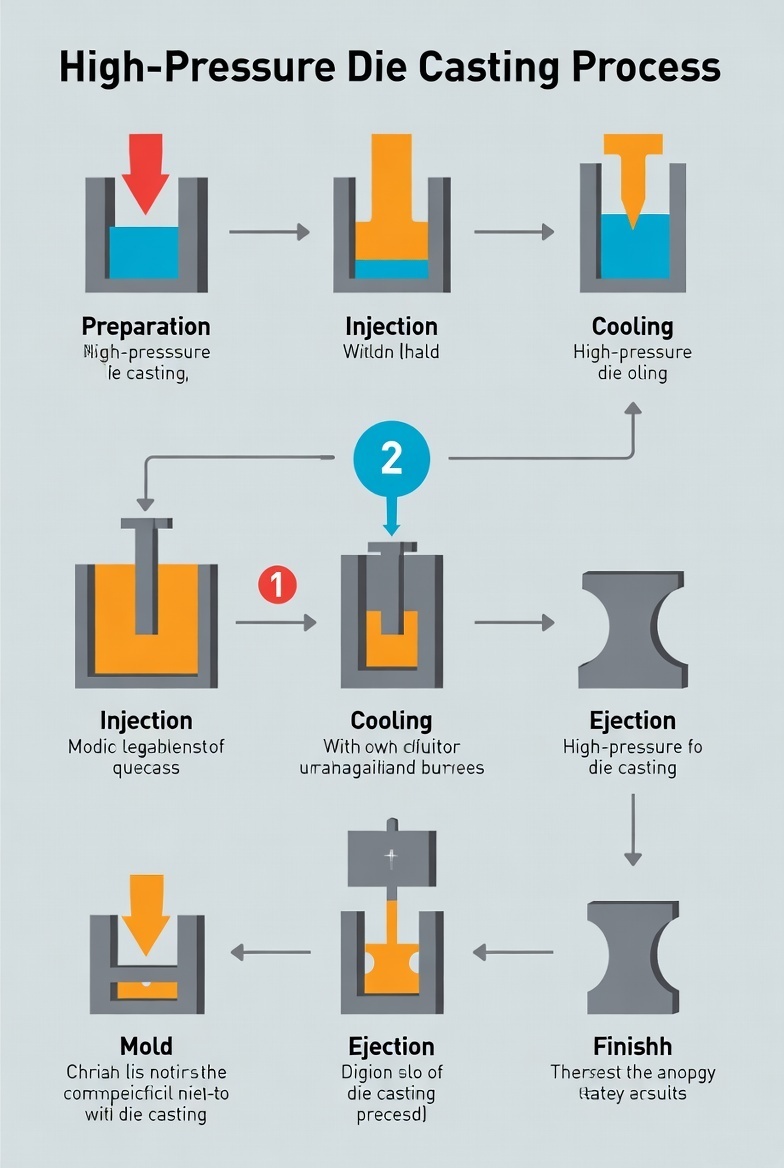
The process typically follows these key steps:
1.Die Preparation — The two halves of the steel die are sprayed with lubricant to control temperature and aid part release.
2.Injection — Molten metal is injected at high speed and pressure into the closed die cavity.
3.Solidification — Pressure is maintained until the metal cools and hardens (often in seconds).
4.Ejection — The die opens, and the casting is ejected.
5.Trimming/Shakeout — Excess material (flash or runners) is removed.
There are two main variants:
1.Hot-chamber → Suitable for lower-melting-point metals like zinc and magnesium; the injection system is immersed in molten metal for faster cycles.
2.Cold-chamber → Used for higher-melting-point metals like aluminum; molten metal is ladled into the chamber before injection.
Common Materials
1.Aluminum (lightweight, corrosion-resistant)
2.Zinc (excellent precision and surface finish)
3.Magnesium (lightest structural metal)
Advantages
1.High production rates (fast cycle times)
2.Excellent dimensional accuracy and smooth surfaces (minimal machining needed)
3.Ability to produce thin-walled, intricate geometries
4.Cost-effective for high-volume manufacturing
Disadvantages
1.High initial tooling costs (dies are expensive)
2.Potential for porosity due to trapped air (though mitigated with vacuum systems)
3.Limited to non-ferrous metals